He Meant What He Said: Why the Eucharist Is Truly the Body and Blood of Jesus
On my journey to becoming Catholic (I get baptized this Easter), I’ve found myself longing more and more to receive the Eucharist.
Coming from a Protestant/non-denominational background, it was something I honestly never really knew about.
And now, that feels crazy to me… because of how central it actually is.
The more I’ve researched, the more I’ve realized that this isn’t a small part of the faith.
It’s everything.
During my OCIA classes I knew the Eucharist was important.
I knew it wasn’t just bread.
I knew it was sacred.
I knew it mattered.
But I don’t think I fully understood how much it mattered until I started really looking into it.
Not just what I had heard.
But what Jesus actually said.
What His disciples believed.
What the early Church never questioned.
And what has been confirmed again and again throughout history.
And the deeper I went, the clearer it became:
The Eucharist isn’t symbolic.
It isn’t just a remembrance.
It is truly the Body and Blood of Jesus Christ.
What Jesus Said (and Didn’t Take Back)
In The Gospel of John chapter 6, Jesus says:
“I am the bread of life.”
“My flesh is true food, and my blood is true drink.” (John 6:55)
This wasn’t vague.
It wasn’t poetic.
And the people listening understood exactly what He was saying because they were shocked.
They responded:
“How can this man give us his flesh to eat?”
If they misunderstood Him, this was the moment to clarify.
But He didn’t.
He repeated Himself, even more intensely.
And then:
Many of His disciples walked away. (John 6:66)
Not because it was unclear but because it was too real.
And Jesus let them go.
Because He meant it.
Foreshadowed From the Beginning: The Passover Lamb
Long before Jesus ever spoke about the Bread of Life God was already preparing His people to understand it.
In the book of Exodus, during the first Passover, God gives very specific instructions to the Israelites:
They were to sacrifice a lamb.
Spread its blood on their doorposts.
And eat the lamb.
Not just observe it.
Not just believe in it.
Eat it.
This wasn’t optional, it was part of their salvation.
The blood marked them so death would pass over.
But the meal… the eating… was how they participated in it.
And this is where everything starts to connect.
Jesus isn’t just randomly talking about His flesh and blood in John 6.
He is revealing Himself as the new Passover Lamb.
When John the Baptist first sees Jesus, he says:
“Behold, the Lamb of God.”
Not a symbol.
A fulfillment.
At the Last Supper, which was a Passover meal,
Jesus takes bread and wine and says:
“This is my body… this is my blood.”
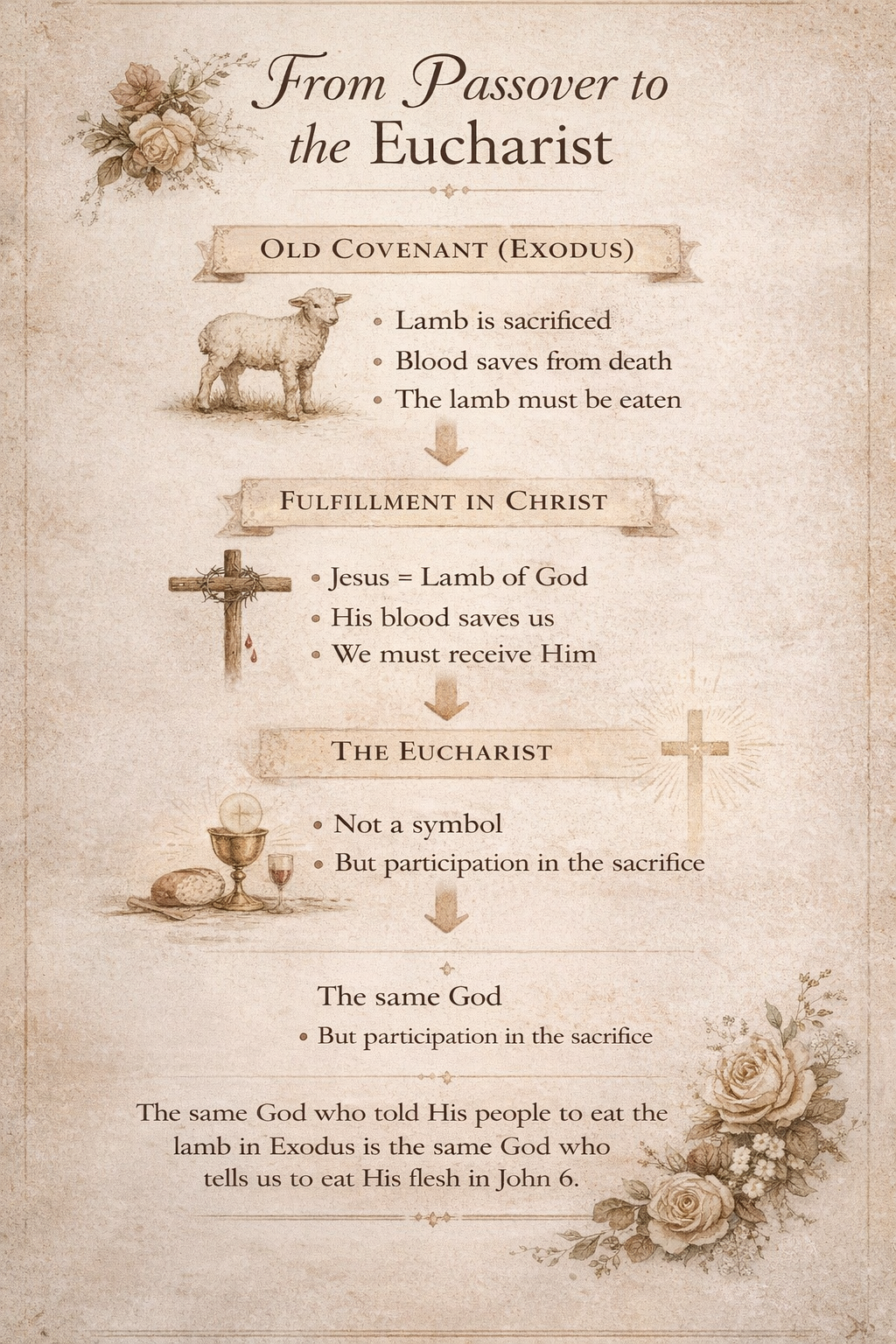
And suddenly, the pattern is complete:
• In the Old Covenant → a lamb was sacrificed, and its blood saved them
• In the New Covenant → Jesus is the Lamb, and His blood saves us
But just like before, it doesn’t stop at the sacrifice.
We are still called to eat.
This is why Jesus’ words in John 6 are so direct.
Because in the Passover, it wasn’t enough for the lamb to die.
It had to be consumed.
And that’s exactly what the Eucharist is.
Not a symbol of the Lamb.
But participation in the Lamb.
Why This Changes Everything?
When you see this connection, the Eucharist stops being something confusing…
and starts becoming something consistent.
God wasn’t changing His plan.
He was fulfilling it.
The same God who told His people to eat the lamb in Exodus is the same God who tells us to eat His flesh in John 6.
The Last Supper: Not a Symbol, but a Gift
At the Last Supper, Jesus takes bread and wine and says:
“This is my body… this is my blood.”
(The Gospel of Matthew 26:26–28)
Not “this represents.”
Not “this is like.”
This is.
And from that moment forward, this became the center of Christian worship.
How Does It Become the Body and Blood of Jesus?
This is where a lot of people pause.
Not what Catholics believe, but how it happens.
Because when we say the bread and wine become the Body and Blood of Jesus…
we mean it literally.
At every Mass, when the priest repeats the words of Jesus:
“This is my body… this is my blood”
something happens that we cannot see, but is completely real.
The Church calls this transubstantiation.
Which simply means:
The substance changes, even if the appearance does not.
It still looks like bread.
It still tastes like wine.
But what it is, at its deepest reality, is no longer bread and wine.
It is Jesus.
Body, Blood, Soul, and Divinity.
Why a Priest?
Because this isn’t something we do on our own.
At the Last Supper, Jesus gave this authority to His apostles when He said:
“Do this in remembrance of me.”
That authority has been passed down through apostolic succession, from the apostles to priests today.
So when a priest celebrates Mass, he’s not acting on his own.
He’s acting in the person of Christ.
Which means:
It’s Jesus who makes it happen.
Not Just a Symbol—A Mystery Rooted in Reality
This isn’t something we fully understand.
But it’s also not something that appeared later in history.
When you look at:
What Jesus said
The authority He gave His apostles
What the earliest Christians believed
…it becomes clear:
This has always been the belief of the Church.
What the Apostles Passed Down
If the Eucharist were symbolic, we would expect confusion early on.
But we don’t see that.
We see consistency.
The apostles didn’t treat it as a metaphor, and neither did the people they taught.
The Apostolic Fathers: Closest to the Source
These were men taught directly by the apostles.
Ignatius of Antioch (AD 107) wrote:
“The Eucharist is the flesh of our Savior Jesus Christ.”
Justin Martyr (AD 155):
“We do not receive these as common bread and drink… but as Jesus Christ made flesh.”
Irenaeus of Lyons(AD 180):
The bread becomes the Eucharist—the body of Christ.
They didn’t debate this.
They preserved it.
The Early Church Didn’t Change This
Across centuries, cultures, and languages, the belief remained the same:
The Eucharist is truly Jesus.
Not a later invention.
Not a theological development.
But something handed down from the beginning.
The Saints Lived This Reality
The saints didn’t just believe this, they lived it.
St. Clare of Assisi held the Eucharist in faith, and enemies fled.
St. Thérèse of Lisieux approached the Eucharist with deep love and longing.
St. John Vianney said:
“If we really understood the Eucharist, we would die of joy.”
For them, this wasn’t ritual.
It was Jesus.
When the Invisible Becomes Visible
Most of the time, the Eucharist looks like bread and wine.
But sometimes, God allows what is hidden to be seen.
The Eucharist Miracle of Lanciano
—scientifically identified as human heart tissue.
The Eucharistic Miracle of Buenos Aires
—again, living heart tissue.
The Eucharistic Miracle of Legnica
—same results.
Different places. Different times.
Same reality.
Why This Matters
If you’ve always seen the Eucharist as symbolic, I understand that.
But when you look at:
What Jesus actually said
How His disciples reacted
What the earliest Christians believed
The consistency of the Church
The witness of the saints
And even the miracles
…it becomes difficult to reduce it to a symbol.
Because symbols don’t cause disciples to walk away.
Symbols don’t remain unchanged for 2,000 years.
And symbols don’t become living human heart tissue.
A Personal Reflection
For me, this has become really personal. Not just something I’ve learned, but something I feel.
Because right now, I’m in this in-between place.
I understand what the Eucharist is.
I believe it.
I know it’s true.
But I can’t fully receive yet.
And somehow… that’s made me want it even more.
There’s something about knowing that Jesus is truly present, not symbolically, not spiritually in a distant way, but really there and having to wait.
It’s created this kind of longing in me that I didn’t expect.
Not just to go to Mass.
Not just to learn more.
But to be close to Him in that way.
And I think that’s what changed for me.
The Eucharist stopped being something I understood and became someone I desire.
Because this is truly Jesus. His Body, His Blood, His presence. This isn’t just something we do. It’s not routine. It’s not tradition for tradition’s sake. It’s an invitation into intimacy with Him. And I don’t want to miss that.
I don’t want to approach it casually.
I don’t want to go through the motions.
I want to be fully present.
Fully open.
Fully aware of what I’m receiving.
So right now, in this season of waiting, I’m learning how to prepare my heart.
To slow down.
To desire Him.
To recognize that this is something sacred.
Because soon… I won’t just be learning about the Eucharist.
I’ll be receiving Him.
The Invitation Still Stands
In John 6, many walked away.
And Jesus let them.
Because He doesn’t force belief.
He invites it.
And that same invitation is here:
Will you take Him at His word?