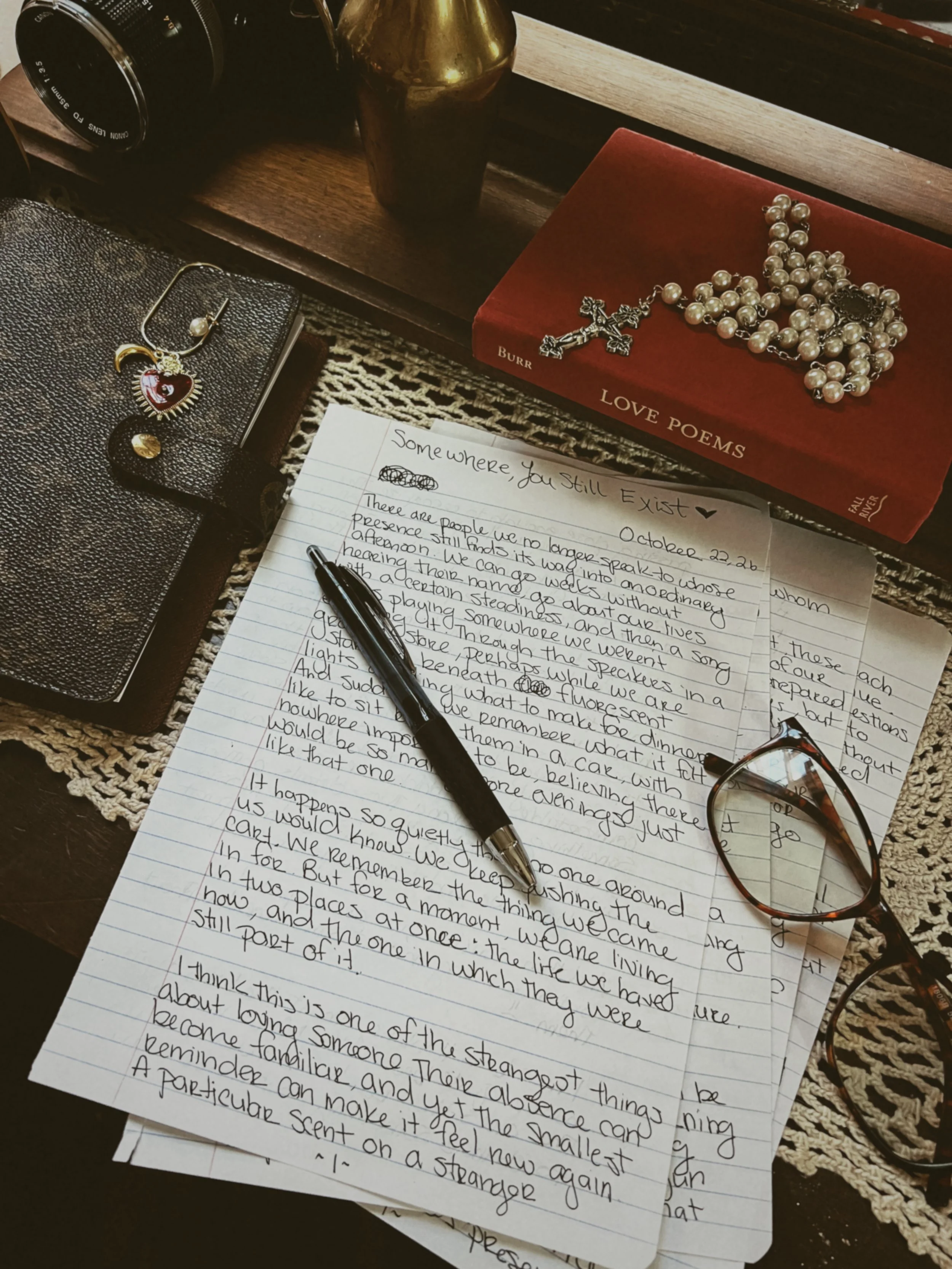
Somewhere, You Still Exist
There are people we no longer speak to whose presence still finds its way into an ordinary afternoon. We can go weeks without hearing their name, go about our lives with a certain steadiness, and then a song begins playing somewhere we weren’t expecting it. Through the speakers in a grocery store, while we are standing beneath fluorescent lights deciding what to make for dinner. And suddenly we remember what it felt like to sit beside them in a car, with nowhere important to be, believing there would be so many more evenings just like that one.
It happens so quietly that no one around us would know. We keep pushing the cart. We remember the thing we came in for. But for a moment, we are living in two places at once: the life we have now, and the one in which they were still part of it.
I think this is one of the strangest things about loving someone. Their absence can become familiar, and yet the smallest reminder can make it feel new again. A particular scent on a stranger passing close enough to recognize. The sound of someone laughing in another room. A certain kind of weather. Evening light coming through a window at the same angle it did on a day we hadn’t realized we would keep.
We spend so much time learning a person without knowing we are learning how to remember them. We notice the way they take their coffee, the expression they make when they are trying not to smile, the things they say when they are tired enough to stop choosing their words so carefully. We learn which silences are comfortable and which ones mean something is wrong. These details gather slowly, almost without our permission, until another person has become part of how we move through the world.
And then, somehow, we are expected to continue living in that same world without them.
I have been thinking about the loves that never quite become the life we imagined. The ones that reach far enough into us to change something, but never stay long enough for us to understand what we are supposed to do with that change. We call them almosts, perhaps because we need a word small enough to contain a story that still feels too large to explain.
Almost love. Almost a future. Almost someone we could have grown old beside.
But there is something unfair about that word, too. Because when we say almost, it can sound as though very little happened. As though we stood at the edge of something and never stepped inside. Yet sometimes we were deeply inside it. We were hopeful. We were tender. We let someone know us in ways we had been afraid to be known, and for a while, being seen by them felt like being given somewhere to rest.
What remained unfinished was the future. The feeling had already happened.
I think that’s why that type of love can be so difficult to grieve. We are mourning a person, but we are also mourning all the ordinary days we had begun to place them in. The mornings that would have belonged to us. The dinners we might have made. The familiar sound of their arrival. We had started making room for them in a life that had not happened yet, and when they leave, those rooms remain.
There is no memory to put there, only an expectation. An empty chair at a table we never actually sat around together.
I wonder how much of heartbreak is learning to stop waiting for those imagined days. How long it takes to make plans without quietly leaving space for someone to return. How many times we must catch ourselves thinking, They would love this, before the thought becomes something we can hold gently instead of something that ruins the afternoon.
Because there is a tenderness in remembering that can be almost unbearable. It is difficult to explain how much we can miss a simple thing. Someone reaching for our hand without looking. The ease of hearing their voice at the end of a long day. Being asked whether we made it home. The feeling of having a thought and knowing exactly whom we wanted to tell.
When someone is no longer present, these small exchanges reveal how much of our life they occupied. We may have prepared ourselves to lose the larger things, but it is the quiet habits that keep finding us unprepared. Something funny happens, and for half a second we forget. Our hand moves toward the phone before our mind remembers there is nowhere for that particular kind of happiness to go anymore.
There is a very lonely moment between wanting to tell someone and remembering why we cannot.
And still, beneath the sadness, I find myself wondering at the beauty of having wanted to tell them at all. Of having known a person whose presence made an ordinary experience feel more complete because it could be shared. Of having cared so deeply that some instinct in us still turns toward them before it turns back toward the life we are living now.
I don’t always know what to do with that beauty. Sometimes I wish it would make the grief easier, but often it makes it harder. If there had been nothing good, maybe there would be less to miss. Instead, we are left holding memories that do not become less lovely simply because we can no longer return to them.
A happy memory can hurt precisely because it was happy.
For a long time, I think I wanted endings to explain everything that came before them. I wanted the final page to tell me what the story had meant, whether the tenderness was real, whether I had been foolish to believe in it. There is a certain comfort in imagining that an ending can settle all of those questions. If it ended, maybe we were wrong. If it had been love, maybe it would have stayed.
But people are more complicated than the conclusions we try to make of them. A relationship can contain genuine affection and still be unable to carry a shared life. Two people can give each other something meaningful and still reach a place where they cannot continue. Sometimes the ending leaves questions that neither person knows how to answer, and we have to live without the clean understanding we hoped grief would eventually provide.
I am learning that I can be grateful for a moment without asking it to justify every moment that followed. I can remember feeling loved without making the whole story beautiful. There are things I would never want to experience again, and there are things within the same chapter that I would be lying if I said I wished had never happened.
Faith makes me bring these questions to God, though it doesn’t always make them easier to answer. I have prayed over the people who have passed through my life and wondered why closeness can be given so briefly. Why we are allowed to feel the comfort of someone’s presence, to become accustomed to it, and then have to learn how to sleep, eat, pray, and make plans in the space they leave behind.
Sometimes I wonder whether God allows a love to belong to a particular season, even when we are hoping it will belong to all of them. Whether there are moments of being cherished that we are meant to receive without being able to keep the person through whom they came.
I say this carefully, because I don’t know the reasons for every loss. I cannot look at someone’s departure and confidently call it God’s intention. People make choices, and some choices wound us. I don’t believe we have to make those wounds sound holy in order to bring them to Him.
But I do believe He can meet us in the life that remains. I believe He can receive our gratitude and our disappointment in the same prayer, without asking us to simplify either one. He knows why we miss someone. He knows which memory we return to when we can’t sleep. He knows that sometimes, when we ask Him to help us let go, there is still a quiet part of us hoping He will give them back. He hears how my heart needs them but my mind reminds me how I don’t.
There is something comforting about being able to admit that to God. To stop trying to pray as though we are further along than we are.
Some nights, the most honest prayer may be, I know they aren’t here, but I still love them. Please help me live here too.
Because that is what I want to learn: how to live fully in a life that still contains traces of people who are gone. How to let a memory visit without giving the rest of the day away to it. How to hear the song and stay in the room. How to be thankful that I was once happy in a certain place, then go there again and discover what it feels like now.
I don’t think healing requires us to become strangers to our own past. I hope it allows us to remember with more freedom. To reach a point where the memory no longer carries an instruction to return, or a demand to understand, or a promise that if we think about it long enough we might change how it ended.
Perhaps one day it can simply be a memory: something tender that happened to us, held among all the other things that have made up a life.
There may always be a part of us that remembers who we were beside that person. The way we laughed more easily, or felt beautiful without trying, or found ourselves speaking about a future we had once been afraid to want. Even after we have accepted their absence, we may still feel affection for that version of ourselves. She was hopeful. She was willing. She had no way of knowing the ending when she opened the door.
I want to be gentle with her.
I want to stop judging her for believing that something beautiful might last. There was nothing shameful about wanting to be loved, or about responding when love seemed to reach for her. Whatever she understands now, she did not have that understanding then. She was living the days as they came, discovering another person, allowing herself the very human happiness of being close.
And I hope, when the time comes, she will allow herself that happiness again.
That may be the part that takes the most courage. After loss, we know so much more about what an ordinary goodbye can become. We know that a familiar voice can one day belong to someone we never hear from. We know how long a scent can remain attached to a person, how unexpectedly a date on the calendar can hurt. To love again is to know all of this and still make room for someone.
I pray I never become so afraid of the ending that I refuse the life that comes before it.
For now, I am making peace with the possibility that some people will always live quietly within us. Their place may grow smaller. We may stop visiting it so often. There may come a day when we realize we have gone a whole afternoon, a whole week, without looking back. Yet somewhere, a song will still belong to that beautiful chapter, and a certain fragrance will still carry us briefly to a doorway where we were once happy to be expected.
I hope that when those moments find me, I can receive them without mistaking them for a call to return. I hope I can remember that I was there, that I felt deeply, that something in those days was precious to me. Then I hope I can turn toward whatever is in front of me, the groceries waiting to be put away, my dog needing a walk, the dinner I am making, the evening light falling across a home that is still mine to fill.
Maybe I will never know why a particular love could only stay for a moment. I can bring that question to God for the rest of my life if I need to. But I hope, in time, I will spend less of my life asking Him to explain the departure, and more of it trusting Him with what comes after.
The song will end. I will remember what I came in for. And somewhere between the ache of having loved and the grace of being able to keep living, I’ll smile and remember how beautiful it felt, to almost have it all with them.